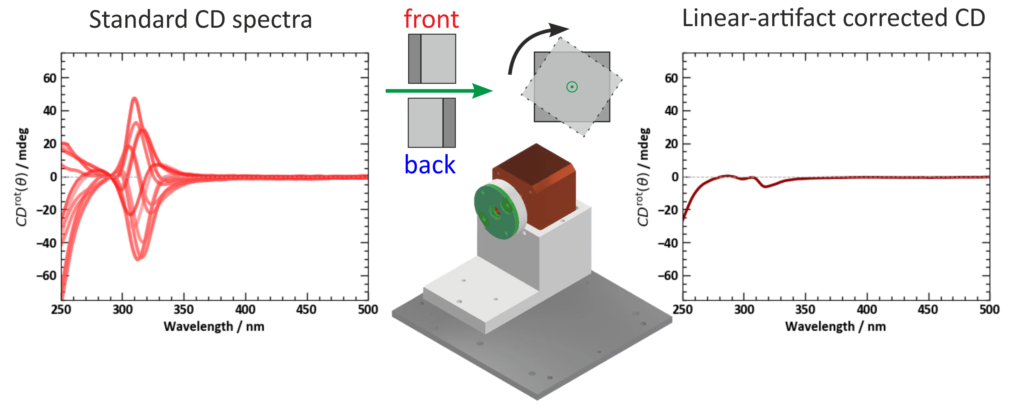
A new paper from our collaboration with colleagues at TU Chemnitz and Hasselt University is now out in Applied Physics Letters.
Circular dichroism spectroscopy is increasingly used to study chiral thin films, but optical anisotropy can introduce linear-dichroism and birefringence contributions that masquerade as genuine chiroptical signals. In this work, we present a practical step-by-step workflow combining azimuthal sample rotation with front/back measurements to identify and suppress these artefacts.
Using molecular thin films and chiral hybrid perovskites as test systems, we show how the approach allows the genuine circular-dichroism response to be separated from linear optical contributions. The paper also provides the experimental implementation, including a motorised rotation stage and accompanying code.