KahmannLab goes Holzhau XXII
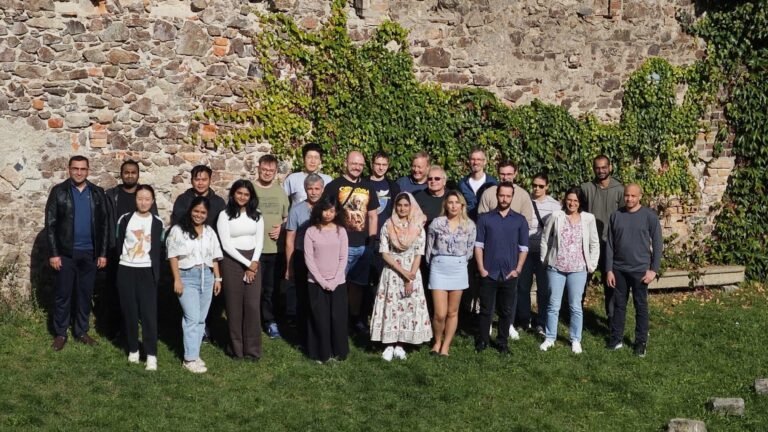
Last week, we exchanged the lab for a change of scenery and met with the HLPH group for a joint workshop in Görlitz.
Last week, we exchanged the lab for a change of scenery and met with the HLPH group for a joint workshop in Görlitz.
We are very happy to welcome Paundra Pratama to the KahmannLab as a DAAD visiting researcher. Paundra is a PhD candidate in Materials Science and Applied Chemistry at Kumamoto University in the group of Prof. Tetsuya Kida. His research focuses on colloidal metal-halide nanocrystals, particularly the roles of ligand and surface chemistry, lattice metastability, and […]
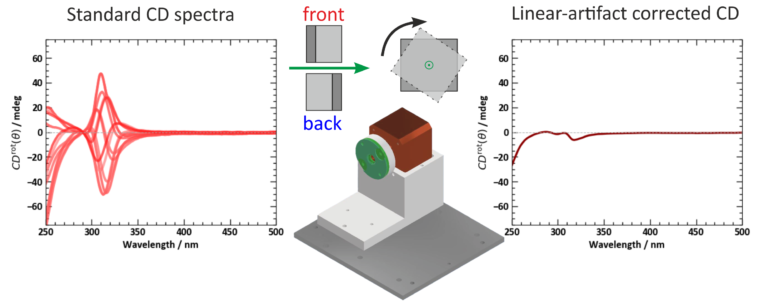
A new paper from our collaboration with colleagues at TU Chemnitz and Hasselt University is now out in Applied Physics Letters. Circular dichroism spectroscopy is increasingly used to study chiral thin films, but optical anisotropy can introduce linear-dichroism and birefringence contributions that masquerade as genuine chiroptical signals. In this work, we present a practical step-by-step […]
We are pleased to highlight the Small Structures special collection “Exploiting Dimensionality in Hybrid Metal Halides – Design, Properties, Applications,” co-edited by Simon together with Wouter Van Gompel, Silvia G. Motti and Bowen Yang. The collection brings together contributions exploring how structural and electronic dimensionality can be used to control the properties of hybrid metal […]
A new look for the KahmannLab website Our website has had a substantial overhaul. Over the past week, we have rebuilt large parts of the site to make it easier to navigate, easier to keep up to date, and more representative of the way we actually think about our research. The new version now brings […]
Khadija Khaled has received a 2026 Mothers in Science Caregiver Travel Grant to support her participation in an international scientific conference.
Hayley concludes her postdoctoral work in the KahmannLab and returns to the UK for her next chapter.
Çağlar presented the photocurrent microscope that he designed and assembled for high-resolution stage-scanning measurements.
The group spent a week at MATSUS Spring in Barcelona, exchanging ideas with colleagues and developing new collaborations.
Continuing the postdoc intake, we are very happy to have Min-Gi Jeon join us from Korea. Min-Gi will join the NachLeuchten project and focus on light-emitting diodes based on solution-processed and lead-free semiconductors. Welcome!
Hayley joins the group as a postdoctoral researcher and strengthens our work in multimodal microscopy.
A Nature Nanotechnology paper combines high-resolution electron microscopy and hyperspectral photoluminescence microscopy to investigate unusual low-temperature emitters in FAPbI3.
The KahmannLab advertised a doctoral or postdoctoral position focused on LED fabrication and characterisation.
The KahmannLab joined the OPKM group for a hike around Chemnitz, passing Rabenstein Castle and taking in views of the surrounding countryside.
With several new members joining, the group assembled for an updated KahmannLab photograph.
Çağlar joins the KahmannLab for a master’s research project developing photocurrent microscopy for spatially resolved solar-cell measurements.
Dobromił Respekta joins the KahmannLab to investigate ultrafast spectroscopy and energy transfer in two-dimensional perovskites.
Members of the KahmannLab joined the Semiconductor Physics group for a visit to the Markersbach pumped-storage plant.
Phillip Börner joins the microscopy laboratory as a research assistant alongside his master’s studies in physical engineering.
An ACS Photonics paper shows how resonant-cavity engineering can produce efficient narrowband perovskite photodetectors with tuneable spectral sensitivity.
A Nature Reviews Methods Primers article surveys photoluminescence-microscopy methods, practical considerations, and figures of merit for modern optoelectronic materials and devices.
A Nature Nanotechnology study explains how dynamic local structures of lower symmetry coexist with the average crystal structures measured by X-ray diffraction.
The group invited prospective Marie Skłodowska-Curie and Humboldt fellowship applicants to develop collaborative postdoctoral research proposals.
Chemnitz University opened applications for its English-taught master’s programme in Advanced Functional Materials.
Simon’s ACS Materials Letters Viewpoint examines the pathways, experimental probes, and terminology used to describe broadband luminescence in perovskite-inspired semiconductors.
The group attended the 21st Holzhau Meeting in Karlovy Vary for scientific exchange, brainstorming, and time in the Ore Mountains.
The WEAVE programme will fund INTENSITY, a collaboration on singlet and triplet energy transfer in two-dimensional hybrid perovskites.
Khadija Khaled joins the group as an ESF-funded doctoral researcher working on operando optoelectronic microscopy of solution-processed solar cells.
Mst Azra Jabin joins the KahmannLab for a master’s thesis on exciton diffusion in disordered semiconductors.
The second edition of the master’s course Halide Perovskites in Optoelectronics begins with the new winter term.
The new Discovery NX femtosecond laser system arrives for time-resolved spectroscopy and microscopy across a broad spectral range.
A Nature Communications paper shows how photonic engineering can control the directionality of photoluminescence and electroluminescence from perovskite LEDs.
Simon and Shenyu attended the International Conference on Science and Technology of Synthetic Electronic Materials in Dresden.
The group advertised a doctoral project on the photophysics of organic–inorganic materials for light-emitting diodes.
Shenyu visited the KahmannLab in Chemnitz before attending ICSM in Dresden and took the customary visitor photograph.
Federico returned to Cagliari after six months with the KahmannLab to complete his doctorate.
Arina, Mengru, and Simon attended the Sino-German Workshop on Printable Photovoltaics in Erlangen.
Almost one year after the group’s official start in Chemnitz, the team assembled for its first formal group photograph.
Two students undertook externally hosted projects on perovskite solar cells and carbon nanotubes with KahmannLab involvement.
Construction began on a light-tight, laser-safe enclosure for the group’s femtosecond spectroscopy and microscopy system.
A successful DFG instrumentation proposal will provide a femtosecond laser system and a fast camera for time-resolved spectroscopy and microscopy.
Simon was appointed a liaison lecturer for the Friedrich-Ebert-Stiftung, supporting its scholarship work in the natural sciences.
The group invited prospective doctoral candidates to develop ESF Plus scholarship proposals in photophysics and optoelectronics.
A Matter paper led by Xiyu Luo examines heterogeneity in blue perovskite light-emitting diodes.
The KahmannLab joined the DeibelLab for a visit to the Chemnitz Christmas market and an end-of-year dinner.
Arina Narudin moves from Brunei to Chemnitz to begin doctoral research on perovskite-inspired materials and their photophysics.
Federico Pitzalis joins the group from the University of Cagliari for a visiting project on carrier diffusion in two-dimensional perovskites.
Mengru Sun joins the group as its first Chemnitz-based doctoral researcher, working on spectroscopy and microscopy of solution-processed semiconductors.
The group launched a new master’s course on halide-perovskite materials and their photovoltaic and light-emitting applications.
The group advertised two doctoral positions in optical spectroscopy and microscopy, and in the synthesis of perovskite and perovskite-inspired materials.
Simon was appointed Assistant Professor of Experimental Semiconductor Physics at Chemnitz University of Technology and began establishing the new laboratory.
Ayla Dekker visits Cambridge and the StranksLab for a five-month master’s project on chiral perovskites.
Shenyu Nie joins the group for doctoral research on optical communication using solution-processed nanomaterials, with a focus on halide perovskites.
Simon co-organised a MATSUS 2023 symposium on two-dimensional perovskites in Valencia.
The first KahmannLab website went online, establishing the group’s initial digital presence.